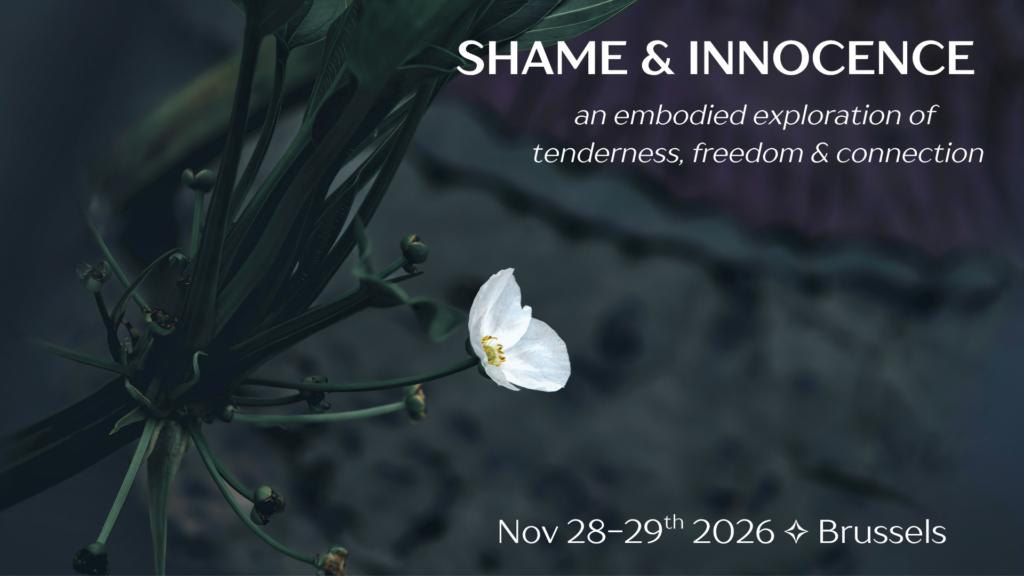
In collaboration with Markus Schnizer & Marysia Pstrokonska
Shame is one of the hardest experiences to name, and one that shapes us on a deep level.. It is complex and it runs deep. It touches identity, survival, connection, and longing. It moves through nervous systems, families, cultures, and collective stories. It is not only a thought or a belief. It can live in the body as a filter on reality, so familiar we barely notice it. It shapes what feels safe to express, what feels “too much,” and what we brace for others to reject. Like a “no” we learned to offer ourselves before anyone else can.
And if we are honest, shame is not something most of us want to look at, especially not in front of other people.
So why would we?
Because so much of what shapes us lives beneath the surface. And when we build capacity to stay with the sensations and meanings of shame, gently and at our own pace, something can begin to soften. We stop abandoning ourselves when it gets uncomfortable. We stop assuming every contraction is a signal to hide. We learn to stay, to listen, and to meet what matters to us.
This weekend is an invitation into tender, real, embodied exploration of shame and innocence, together.
Not innocence as naivety, purity, or pretending nothing happened. Innocence here is something else. Something we can return to. A kind of inherent dignity that remains, even after experience. A place in us that knows play, aliveness, and choice.
Over the weekend, we will explore
- Shame as a lens and how it shapes perception, identity, and belonging
- The intelligence inside shame and how it has protected connection and belonging
- What it costs us when shame runs the show, often invisibly
- Building nervous system capacity to stay present with impulse, longing, feeling and the rhythms of contraction and expansion
- Reconnecting with innocence as freedom, permission, and the pulse of life
We will work through body, energy, and awareness practices. These include consent based touch, movement, meditation, relational inquiry, group processes, and deep connection work. There is no demand to get somewhere.
The invitation is simple and radical: to turn towards ourselves and what has been hidden with kindness, and listen.
Words from previous participants
“It completely shifted my perception — from seeing shame as something woven into my skin, to understanding it as part of the broader human experience.
In this workshop, I witnessed extraordinary bravery, support, and the profound significance of listening, being present & communicating in navigating shame.
I learned that shame doesn’t always require fixing or panicking. Instead, it can be met with curiosity — and, when possible, with the safety of being surrounded by others who can hold it with you.
I feel deeply grateful to have gone through this experience with the incredible but always gentle & professional guidance from Marysia & Markus. Together, they created an environment grounded in honesty & safety, and they were always there to give us the tools to support each other in this process, but most notably ourselves too. “
— Daphne
“Working with shame and innocence may be one of the most challenging aspects of consciousness development. Markus and Marysia are able to create a powerful and safe holding field in which personal themes such as shame, judgment, criticism, and failure are touched on a deep level.
Their approach is both precise and inspiring. In their collaboration, they maintain a clear balance, always allowing participants to stay in touch with their own agency — no matter how vulnerable the process becomes.
Their interventions are honest and supportive, never directive, always inviting.
Through this, it became clear how the willingness to fully feel shame can open the door to innocence — and with it, to one’s own potential and essence.
I was deeply moved — both in my resistance to personal themes and in my inspiration.
What was touched continues to resonate within me.”
— Hans
Practicalities
⧫ Dates: Sat 28th and Sun 29th November 2026
⧫ Timings: 10:00 – 18:00 with a lunch break
(Please arrive at 9:45; the workshop will start at 10:00)
⧫ Location: Centre YAKA, rue Zandbeek 159
1180 Uccle, Brussels
⧫ Online integration call: Tuesday December 8th 19:30-20:45
⧫ To register, send an email to lestime@protonmail.com ⧫
⧫ Pricing:
Early bird pricing by 31st October 2026: € 295
Standard pricing as of 1st November 2026: € 325
Supporter pricing, contributing towards accessibility for others: € 375
If the cost is getting in the way of joining, feel free to write to us and we can explore what might be possible.
Cancellation policy:
Until 31st October 2026: 50% refund
1st November 2026 onwards: no refunds
For questions feel free to reach out to: lestime@protonmail.com
An important note:
* This weekend is an experiential playground for exploring shame and innocence. To fully engage with this work, participants need a basic capacity to regulate their emotions and not be completely identified with their own shame. If shame feels all consuming or overwhelming, this may not be the right container.
Being seen within a group setting is part of the process, and participants are invited to engage with the exercises at their own pace, stepping in and out as much or as little as feels right for them.
⧫ About Marysia and Markus ⧫
Marysia and Markus are both bodyworkers, and have been working together for several years. A lot of what brings them together is a shared fascination with the body’s innate intelligence, and with what can open up when we slow down enough to listen.
Their work together has grown through weekends exploring Shame and Innocence, anger as a life-giving, creative force (Emerging Radiance), and fawning (Becoming what you Need me to Be)… themes that keep appearing in their sessions, their own lives, and the wider territory of being human.
They are both deeply interested in tracking what is happening in the body, staying with what is here, and becoming more skilful at meeting experience without rushing to fix, override or escape it.
For them, the work is not about getting rid of difficult responses. It is about listening closely enough to understand what they are doing, and developing more choice and freedom in how we move with them.
They love creating spaces that are real, exploratory, relational and playful, with room for both depth and lightness.